GEOTECHNICALENGINEERING
NEW WESTMINSTER
HomeSlopes & WallsActive/passive anchor design

Active and Passive Anchor Design in New Westminster

Rigorous testing. Clear reporting.

LEARN MORE

New Westminster sits at the northern edge of the Fraser River delta, where the 1946 Vancouver Island earthquake registered Modified Mercalli intensity VI across the Lower Mainland, a reminder that our dense urban core rests on complex alluvial and glacial deposits. With the city climbing the steep slopes from the riverfront to the uptown plateau at roughly 155 meters above sea level, any deep cut, basement excavation, or retaining structure immediately contends with variable overburden and groundwater regimes. Our anchor design work tackles exactly this intersection of topography and seismicity—whether the project calls for a prestressed active anchor to limit movement behind a shoring wall on Columbia Street or a passive tendon embedded into the glacial till that underlies the Royal City Centre area. By integrating CPT testing profiles with the anchor bond length calculations, we refine the geotechnical model before the first strand is tensioned, avoiding the costly overdesign that generic assumptions often produce in this part of Metro Vancouver.

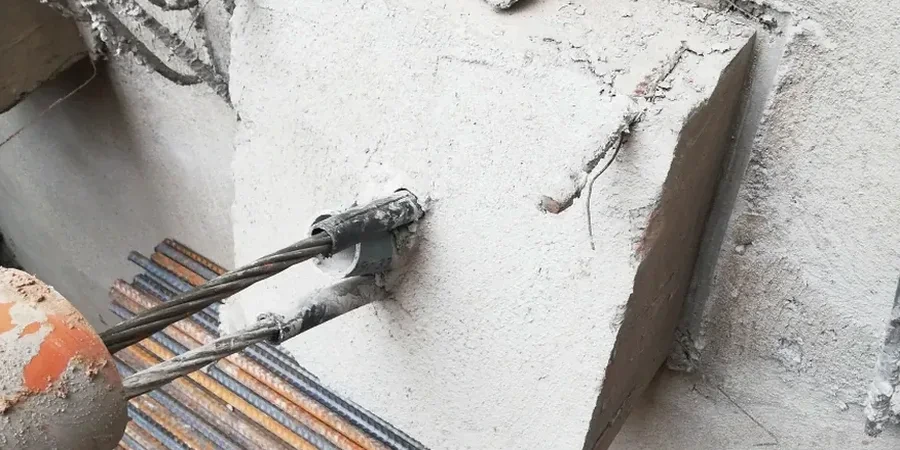
In New Westminster's hillside excavations, a properly designed active anchor limits lateral movement to under 10 millimeters, protecting adjacent century-old masonry structures from differential settlement.
Our service areas

Our approach and scope

When we review borehole logs from Queensborough or the downtown core, one pattern becomes obvious: the transition from compressible silts into dense Vashon till dictates where a passive anchor develops its pullout resistance, and misjudging that contact by even half a meter can halve the ultimate capacity. Our approach relies on instrumented load tests correlated with slope stability analyses, especially on the hillside sites east of 12th Street where the natural grade already operates near its factor of safety. For active anchors, the lock-off load is calibrated against the anticipated excavation sequence, not just the final design earth pressure, because staged construction in New Westminster’s tight urban lots means the wall rarely deflects the way a single-phase model predicts. We specify double-corrosion protection conforming to CSA A23.3 durability requirements, and every anchor assembly is documented with grout cube strengths, tendon elongation records, and lift-off checks before the contractor moves to the next row of tiebacks.
Active and Passive Anchor Design in New Westminster
Technical reference — New Westminster

Local ground factors

New Westminster’s development history stretches back to 1859, making it the oldest incorporated city in western Canada, and that heritage comes with a geotechnical shadow: many downtown blocks are built over former tidal flats infilled with undocumented material, while the uptown neighborhoods sit on advance glacial deposits that can mask buried channels. Foundation excavations that rely on passive anchors without confirming the stratigraphy through targeted boreholes risk encountering compressible lenses that provide negligible passive resistance, which leads to wall rotation and distress in adjacent buildings. The Fraser River’s proximity also means high groundwater levels fluctuate seasonally, reducing effective stress in the anchorage zone. The most serious failure mode we see is progressive anchor creep in overconsolidated clays when the tendon is stressed beyond the residual strength envelope—a condition that develops silently over weeks and only emerges when the shoring begins to lean visibly toward the excavation.

Need a geotechnical assessment?

Reply within 24h.

Email: info@geotechnicalengineering.vip

Relevant standards

NBCC 2020 (National Building Code of Canada, seismic provisions), CSA A23.3-14 (Design of concrete structures – anchorage durability), ASTM A416/A416M-18 (Low-relaxation seven-wire steel strand for prestressed anchors), PTI DC35.1-14 (Recommendations for Prestressed Rock and Soil Anchors), CAN/CSA-S6-19 (Canadian Highway Bridge Design Code – ground anchor provisions)

Reference parameters

ParameterTypical value
Design bond stress in Vashon till (active)250–450 kPa
Typical unbonded length in urban cuts4.5–7.0 m
Minimum lock-off load (% of design)110%
Grout compressive strength at 28 days30 MPa minimum
Corrosion protection grade (permanent)Class II (double barrier)
Proof test load (performance verification)133% of design load
Typical anchor inclination from horizontal15°–30°

Common questions

What distinguishes an active anchor from a passive anchor in a retaining wall design?

An active anchor is prestressed and locked off against the structure immediately after installation, which actively restricts soil movement and is ideal for minimizing settlements behind sensitive urban structures. A passive anchor develops its resisting force only when the wall begins to displace, making it suitable for temporary cuts or sites where minor lateral movement is acceptable. The choice in New Westminster often hinges on the proximity of heritage buildings and the stiffness of the retained soil mass.

How do you determine the bond length for an anchor installed in Fraser River delta soils?

Bond length is derived from the ultimate skin friction between the grout body and the surrounding soil, which we evaluate using CPT sleeve friction data and empirical correlations validated for local deltaic silts and glacial till. We then apply a factor of safety of at least 2.0 for permanent anchors, and verify the design through on-site performance tests that measure creep under sustained load.

What is the typical cost range for anchor design and testing in New Westminster?

The combined cost for anchor design engineering, including load test specifications and construction-phase oversight, ranges between CA$1,350 and CA$4,920 depending on the number of anchor rows, the complexity of the ground profile, and whether instrumented monitoring is required. This range covers typical mid-rise excavation projects; larger infrastructure works fall outside it.

Are active anchors allowed as a permanent support solution under the Vancouver Building Bylaw?

Yes, permanent prestressed anchors are permitted when designed with double-corrosion protection and a monitoring program that includes periodic lift-off checks. The NBCC 2020, which New Westminster adopts, references the PTI DC35.1 recommendations and requires that permanent anchors demonstrate a creep rate below 2.0 mm per log cycle of time during performance testing.

When should proof testing be performed on passive anchors?

Proof testing should be conducted on at least 5% of passive anchors, or a minimum of three anchors per distinct soil zone, loading them to 133% of the design load. In New Westminster's variable ground, we often recommend testing a higher percentage when the bond zone crosses the contact between compressible alluvium and dense till, because the transition can mask weak interfaces that only emerge under load.

Location and service area

We serve projects in New Westminster and surrounding areas.

View larger map