GEOTECHNICALENGINEERING
NEW WESTMINSTER
HomeGround improvementVibrocompaction design

Vibrocompaction Design for the Fraser River Floodplain

Rigorous testing. Clear reporting.

LEARN MORE

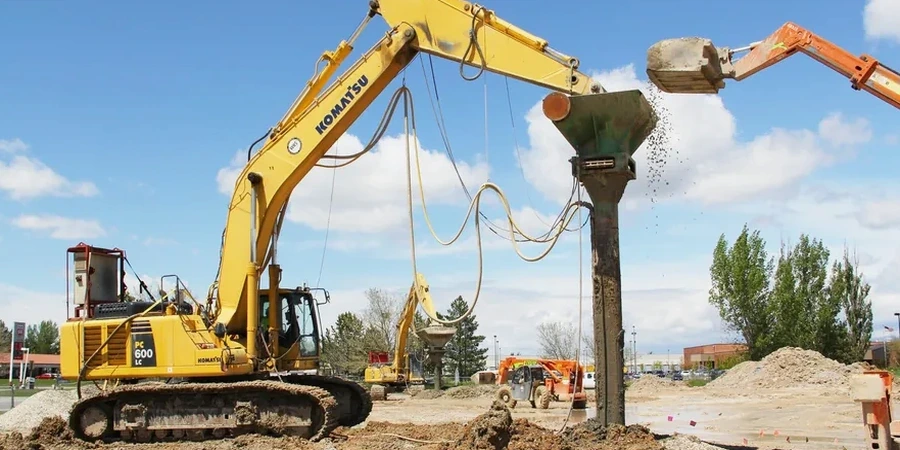
A recent mid-rise project on Columbia Street hit refusal at 2.4 m—classic Fraser River sand, loose and saturated. The structural engineer had specified a shallow footing, but the geotech report flagged liquefaction potential under the NBCC 2020 seismic hazard for New Westminster. We redesigned the ground improvement using vibrocompaction, targeting a relative density above 70% to eliminate the risk. In this part of Metro Vancouver, the subsurface is a post-glacial delta; you are almost always dealing with clean to silty sand that densifies well under vibration. Knowing when vibrocompaction works—and when it does not—comes down to the fines content. Before mobilizing, we often run a CPT test to map the profile continuously, because the transition from sand to silt can be sharp and shallow across the Queensborough reach.

In New Westminster’s deltaic sand, getting the grid spacing right is more important than the vibrator power—miss it by half a metre and you leave untreated lenses.
Our service areas

Our approach and scope

The Quaternary geology under New Westminster is dominated by the Fraser River delta, with sand units reaching 30 m or more near the river. What we see in the field is a loose upper layer—often N-values below 10 blows in an SPT—that compacts readily with depth vibrators. A proper vibrocompaction design here must account for the high water table, typically at 1.5–2.5 m, which is ideal for the process because the saturated sand collapses more efficiently under cyclic loading. The grid spacing we specify is rarely uniform; it tightens near the river bank and loosens slightly toward the upland till. This is not a one-size-fits-all treatment. When the fines content exceeds 15%, we switch to a different logic and often recommend stone columns instead of pure densification, because silty sand does not respond to vibration the same way clean sand does.
Vibrocompaction Design for the Fraser River Floodplain
Technical reference — New Westminster

Local ground factors

The most common mistake we see on New Westminster sites is skipping the pre-treatment CPT and relying solely on SPT data from a wide grid. An SPT every 2 m is too coarse to catch thin silt seams that kill vibro efficiency. When the vibrator hits a silt lens, energy dissipates laterally and the sand below stays loose—exactly the condition that triggered flow slides during the 1946 Vancouver Island earthquake, a scenario that Seed and Idriss later linked to localized loose pockets. Another error is treating the entire site with the same probe spacing. Near the Fraser River’s historic channels, the sand body is not homogeneous; compaction energy must be concentrated where the cone resistance drops below 5 MPa. Missing these zones means you still have a liquefiable layer at depth, and the NBCC requires that the design ground improvement addresses the full column of susceptible soil.

Need a geotechnical assessment?

Reply within 24h.

Email: info@geotechnicalengineering.vip

Relevant standards

NBCC 2020 (National Building Code of Canada, seismic provisions), CSA A23.3 (Design of concrete structures, foundation references), ASTM D6066 (Standard Practice for Determining the Normalized Penetration Resistance of Sands for Evaluation of Liquefaction Potential)

Reference parameters

ParameterTypical value
Target relative density (Dr)70–85% (post-treatment)
Applicable grain size rangeClean sand to silty sand (FC < 15%)
Typical treatment depth8–30 m below grade
Grid patternTriangular or square, 1.8–3.5 m spacing
Vibrator power range130–180 kW electric/hydraulic
Verification methodCPT before/after, zone-specific SPT

Common questions

How much does vibrocompaction design typically cost for a project in New Westminster?

For a standard commercial or multi-family lot in New Westminster, the design phase—including field trials, CPT verification, and stamped reports—generally runs between CA$2,160 and CA$7,400, depending on the grid size and number of test sections required.

What soil conditions in New Westminster are best suited to vibrocompaction?

The ideal profile is clean to slightly silty Fraser River sand with less than 15% fines, a water table within 3 m of grade, and SPT N-values below 15. Much of downtown and Queensborough fits this description, though local silt seams must be mapped first.

How do you verify that the compaction actually worked?

We run CPT soundings at the centroid of each treatment cell before and after the work. The acceptance criterion is a relative density above 70%, or a cone resistance increase that meets the project-specific target—whichever is more conservative under the NBCC seismic hazard for New Westminster.

Can vibrocompaction be used next to existing buildings in New Westminster’s older neighborhoods?

Yes, but with precautions. In areas like the West End, where wood-frame structures sit on shallow footings, we reduce vibration amplitude near the property line and monitor peak particle velocity. A pre-condition survey of adjacent buildings is always part of the scope.

Location and service area

We serve projects in New Westminster and surrounding areas.

View larger map