GEOTECHNICALENGINEERING
NEW WESTMINSTER
HomeGeophysicsElectrical resistivity / VES (Vertical Electrical Sounding)

Electrical Resistivity Surveys for Geotechnical Projects in New Westminster

Rigorous testing. Clear reporting.

LEARN MORE

The contrast between Queensborough’s low-lying deltaic silts and the glacial till uplands around Moody Park is stark, and anyone who has excavated in both zones knows that a single borehole log rarely tells the full story. In New Westminster, where the Fraser River has deposited meters of soft, compressible sediment against Pleistocene drifts, we rely on vertical electrical sounding to bridge the gap between point-source data and the continuous subsurface profile that engineers actually need. The method reads resistivity contrasts that differentiate saturated clay from dense till, helping us map buried channels and perched water tables before a single shovel breaks ground. When combined with targeted test pits to ground-truth the geophysical signatures, the resulting model becomes a reliable foundation for foundation design itself.

A VES line across the New Westminster upland-to-floodplain transition can capture the till-clay interface in a single afternoon, replacing days of exploratory drilling.
Our service areas

Our approach and scope

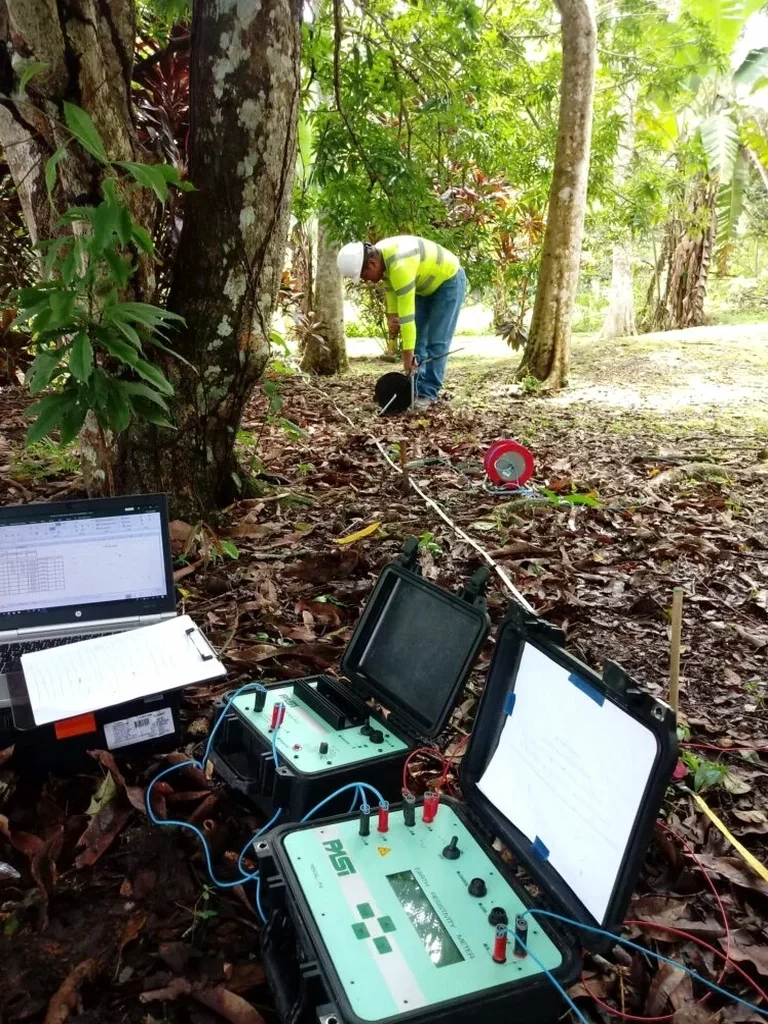
The upland portion of New Westminster sits on a cap of Vashon till—overconsolidated, silty sand with gravel lenses—that typically returns resistivity values above 80 Ω·m when dry, while the underlying glaciomarine stony clay drops below 20 Ω·m due to its higher salt content and saturation. In the Queensborough reach, the Holocene Fraser River sediments are dominated by normally consolidated clay and silt with resistivities often in the 5–15 Ω·m range, making the transition between units unmistakable on a VES curve. Our field crew uses a Schlumberger array with AB/2 spacings up to 200 m to achieve penetration depths exceeding 40 m, which covers the zone of influence for most mid-rise structures governed by NBCC seismic provisions. Because resistivity alone cannot give us strength parameters, we routinely pair the survey with in-situ permeability measurements and grain-size curves from Shelby tube samples, ensuring that low-resistivity anomalies get a geotechnical explanation rather than remaining a geophysical curiosity.
Electrical Resistivity Surveys for Geotechnical Projects in New Westminster
Technical reference — New Westminster

Local ground factors

A 6-storey residential project on Columbia Street encountered a 3-meter-thick lens of organic silt at 9 m depth that had been completely missed by a five-borehole investigation spaced 25 m apart. The lens showed up as a distinct low-resistivity trough on a VES traverse we ran between two existing CPT soundings, and subsequent sampling confirmed wood fragments and a moisture content above 80 %. Without the resistivity curtain, the design team would have proceeded with a shallow footing scheme that would have experienced differential settlement within the first two years of service. In New Westminster, where the Pleistocene-Holocene contact is famously irregular, relying solely on discrete borings can leave critical soft zones undetected. The resistivity method acts as a screening tool that tells us where to concentrate the sampling effort, and it has become standard practice for projects over three storeys on the north bank of the Fraser.

Need a geotechnical assessment?

Reply within 24h.

Email: info@geotechnicalengineering.vip

Relevant standards

NBCC 2020 (seismic site class determination, Section 4.1.8), CSA A23.3-14 (concrete structures, durability requirements influenced by soil resistivity), ASTM D6431-18 (Standard Guide for Using the Direct Current Resistivity Method for Subsurface Site Characterization), BCBC 2024 (British Columbia Building Code, geotechnical investigation scope)

Reference parameters

ParameterTypical value
MethodSchlumberger array (VES), Wenner array optional
Max AB/2 spacing200 m (penetration ~40–50 m in local clays)
Typical resistivity range (till)60–150 Ω·m (unsaturated), 25–60 Ω·m (saturated)
Typical resistivity range (Fraser River clays)3–18 Ω·m
Measurement uncertainty±5 % of reading (calibrated daily against reference resistor)
Data processing1D inversion with smoothness-constrained least squares (RES1D)
Reporting standardASTM D6431-18 guidelines for surface resistivity

Common questions

How much does an electrical resistivity survey cost in New Westminster?

For a typical five-sounding VES campaign with AB/2 max 100 m, the cost ranges from CA$910 to CA$1,430 depending on site access, line clearing requirements, and whether we need to coordinate traffic control on streets like McBride Boulevard. A full 2D ERT line with 72 electrodes generally falls at the upper end of that range or slightly above.

Can resistivity surveys differentiate between contaminated and clean groundwater?

Yes, within limits. Dissolved-phase contaminants that increase ionic concentration—such as landfill leachate or saltwater intrusion from the Fraser River estuary—lower the bulk resistivity of the saturated soil. We have used VES on several New Westminster industrial sites to map the lateral extent of saline plumes, although the method cannot identify specific contaminants; it flags the zone for targeted chemical sampling.

How deep can a VES survey penetrate in New Westminster soils?

With the Schlumberger array at AB/2 = 200 m, we typically reach 40 to 50 meters in the local Quaternary sequence. The actual depth of investigation is controlled by the resistivity contrast between layers and the background noise level, which in urban New Westminster can be influenced by buried utilities and stray currents from the SkyTrain line.

Do you need a building permit or right-of-way approval to run a resistivity line?

If the survey is on private property, generally no municipal permit is required. For work within the road allowance—for example, along Eighth Avenue or on Front Street—we coordinate with the City of New Westminster Engineering Department to obtain a right-of-way permit, which also covers temporary traffic management if electrodes cross a travel lane.

Location and service area

We serve projects in New Westminster and surrounding areas.

View larger map