GEOTECHNICALENGINEERING
NEW WESTMINSTER
HomeInvestigationExploratory test pit

Exploratory Test Pit Services in New Westminster

Rigorous testing. Clear reporting.

LEARN MORE

New Westminster sits at a unique geological crossroads where the Fraser River meets the Burrard Inlet, creating complex soil profiles that shift dramatically within a few city blocks. The steep bluffs from Queensborough up to the Brow of the Hill expose glacial till, marine silts, and loose alluvial deposits that demand direct visual inspection before any structural design begins. An exploratory test pit provides that ground truth in a way that boreholes alone cannot match. Our field crews have opened pits across downtown redevelopment zones, the Victoria Hill area, and the Sapperton industrial corridor, revealing undocumented fill layers and perched groundwater that mapping studies miss entirely. For projects near the Pattullo Bridge replacement zone or the 22nd Street SkyTrain alignment, understanding what lies two to four metres below grade can prevent costly redesigns and foundation overruns.

A single well-logged test pit in New Westminster's variable soils reveals more about construction risk than a dozen boreholes spaced 15 metres apart.
Our service areas

Our approach and scope

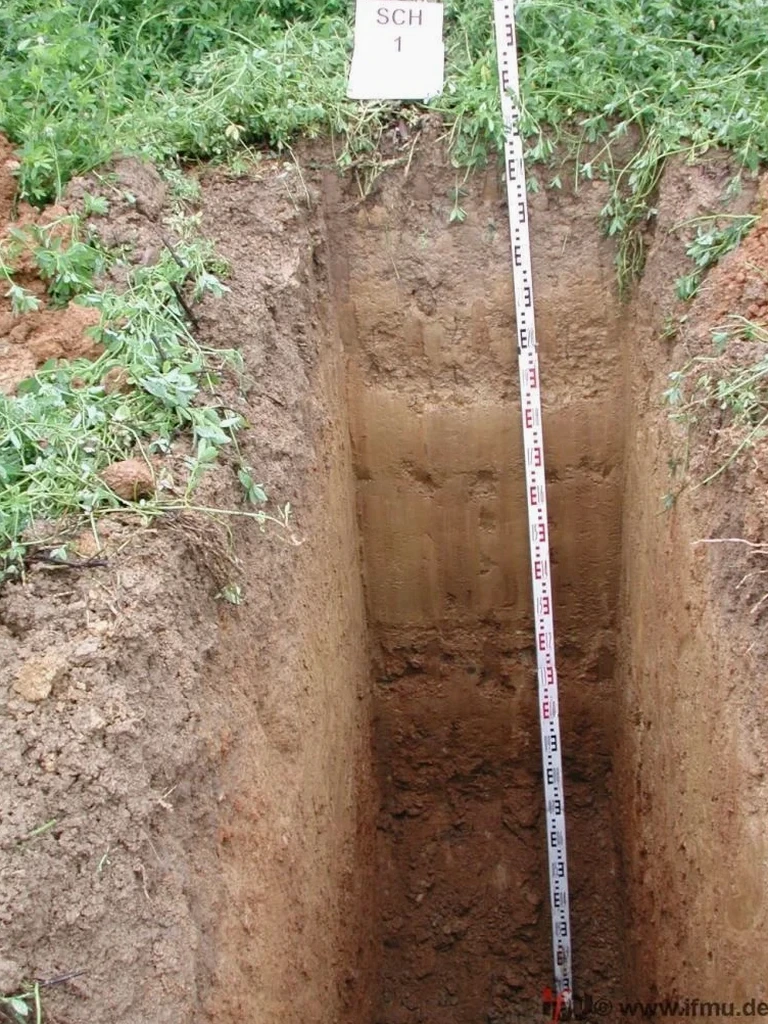
On a recent mixed-use development near Columbia Street, the design team expected stiff glacial till at 2.5 metres. What our test pit actually exposed was a lens of compressible organic silt extending to 3.8 metres, a remnant of an old slough filled during the city's early 20th-century expansion. That single observation shifted the foundation concept from conventional spread footings to a stone columns ground improvement strategy, saving months of settlement delay. We excavate pits typically to 4.5 metres using a tracked excavator with a smooth bucket, then log stratigraphy, photograph the face, and collect undisturbed block samples for laboratory classification. When slope stability is a concern along the steep escarpments of the city, we often combine the visual inspection with a slope stability analysis backed by shear strength parameters derived from those samples. For sites adjacent to existing heritage structures, where vibration from SPT rigs is prohibited, the test pit becomes the primary investigation method and frequently guides the need for retaining walls design along the excavation perimeter.
Exploratory Test Pit Services in New Westminster
Technical reference — New Westminster

Local ground factors

New Westminster's development history spans over 160 years, and much of the downtown core and Queensborough sit on land that was raised, filled, or reclaimed from the Fraser River floodplain between 1890 and 1940. The Great Fire of 1898, which destroyed much of the city's early wooden architecture, also left behind a buried debris layer that still appears in test pits around Front Street and Columbia Street today. Building on undocumented fill without direct visual confirmation introduces settlement risk, differential movement, and potential methane gas migration from decomposing organic material. The city's geotechnical review process, administered through the Development Services department, routinely requires exploratory test pit data for projects within the floodplain hazard area defined by the Fraser Basin Council. Skipping this step has led to foundation redesigns mid-construction and, in one case near the Quay, a 14-month delay when buried timber piles from an old wharf were discovered during footing excavation.

Need a geotechnical assessment?

Reply within 24h.

Email: info@geotechnicalengineering.vip

Relevant standards

NBCC 2020 (National Building Code of Canada), CSA A23.3:19 (Design of concrete structures – foundations), ASTM D2488 (Visual-manual soil description), BC Building Code 2024 (Part 4 – Structural Design), ASTM D4220/D4220M (Soil sampling practices), City of New Westminster – Development Services Geotechnical Guidelines

Reference parameters

ParameterTypical value
Maximum excavation depth4.5 m (standard bucket)
Excavator typeTracked, 3-5 tonne, smooth bucket
Stratigraphic loggingCSA A23.3 compliant field logs
Sample typesDisturbed bulk, undisturbed block (Shelby tube alternative)
Groundwater observationPerched and static level measurement
Backfill specificationCompacted select granular (95% SPMDD)
Typical inspection duration4-8 hours depending on depth and access

Common questions

What does an exploratory test pit in New Westminster typically cost?

The cost for a standard exploratory test pit in New Westminster ranges from CA$590 to CA$1,000, depending on depth, access constraints, and whether undisturbed block samples are required. Pits deeper than 3.5 metres, or located on steep terrain with limited excavator access, fall toward the upper end. This includes mobilization, excavation, professional logging, photography, and backfill compaction.

How do you confirm that backfill material in a test pit is not an old debris layer from the 1898 fire?

The field geologist distinguishes recent engineered fill from historical debris by examining particle angularity, the presence of charred timber fragments, brick rubble, and the stratigraphic position relative to native soils. Samples are taken for grain size analysis and Atterberg limits if the material appears potentially compressible. Historical fire insurance maps from the New Westminster Archives are also consulted when pits are located near Columbia or Front Street.

Is a test pit sufficient for foundation design, or do I also need boreholes?

For shallow foundations on single-family and low-rise commercial projects within New Westminster, a test pit combined with laboratory index testing often provides sufficient data, especially when bedrock refusal is not anticipated. However, for structures exceeding three storeys or sites within the Fraser River floodplain liquefaction zone, test pits are typically supplemented with SPT boreholes or CPT soundings to characterize deeper strata and assess seismic soil behaviour.

Location and service area

We serve projects in New Westminster and surrounding areas. More info.

View larger map