GEOTECHNICALENGINEERING
NEW WESTMINSTER
HomeLaboratoryTriaxial test

Advanced Triaxial Testing in New Westminster for Complex Soil Conditions

Rigorous testing. Clear reporting.

LEARN MORE

The geotechnical complexity of New Westminster, perched on the northern bank of the Fraser River and draped over the ancient glacial deposits of the Vashon Drift, demands a precision that standard index tests simply cannot provide. For projects involving deep excavations near the SkyTrain corridors or high-load foundations on the sensitive Queensborough sands, the triaxial test becomes the definitive tool for measuring shear strength. We run consolidated-undrained (CU) tests with pore pressure measurement as routine, strictly following ASTM D4767, because obtaining effective stress parameters is non-negotiable when designing against the city's characteristic post-glacial silts and clays. A CPT test can provide a continuous profile of tip resistance, but it is the triaxial test that delivers the drained and undrained strength envelopes engineers need for finite element analysis of complex soil-structure interaction under the New Westminster skyline.

A CU triaxial with pore pressure measurement doesn't just give you an undrained shear strength; it reveals the soil's true effective stress path, which is essential for modeling long-term settlement in New Westminster's compressible soils.
Our service areas

Our approach and scope

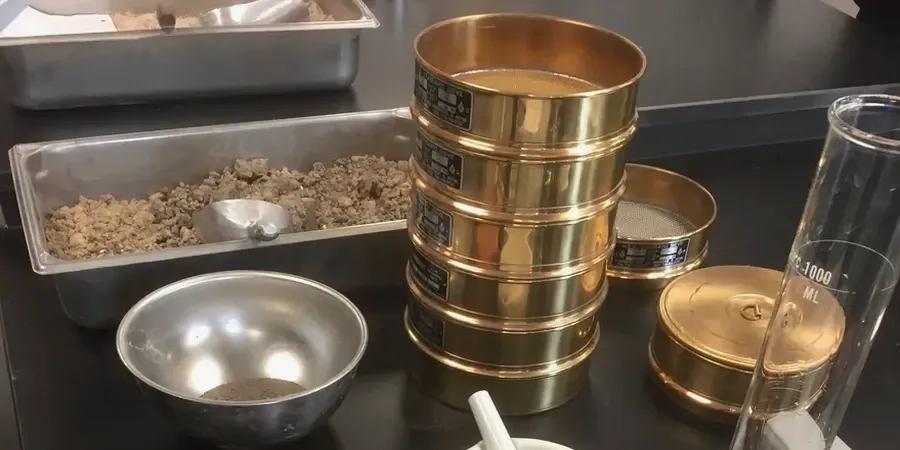
A practical observation from our work across the Lower Mainland, and specifically in New Westminster's Glenbrook North and Sapperton areas, is that the stress history of the local till-like deposits often gets misinterpreted from SPT blow counts alone. We frequently see preconsolidation pressures that don't match simplistic correlations, which is why we insist on high-quality sampling followed by a multi-stage triaxial test program. The material's response to saturation and back-pressure application reveals a lot about its collapsible potential, a risk that becomes apparent when excavating below the water table near the Brunette River. To complement the strength data, we often recommend a grain size analysis to correlate the mechanical behavior with the particle distribution of these glacially-derived soils, ensuring that the chosen effective friction angle is supported by both the test data and the geological depositional environment.
Advanced Triaxial Testing in New Westminster for Complex Soil Conditions
Technical reference — New Westminster

Local ground factors

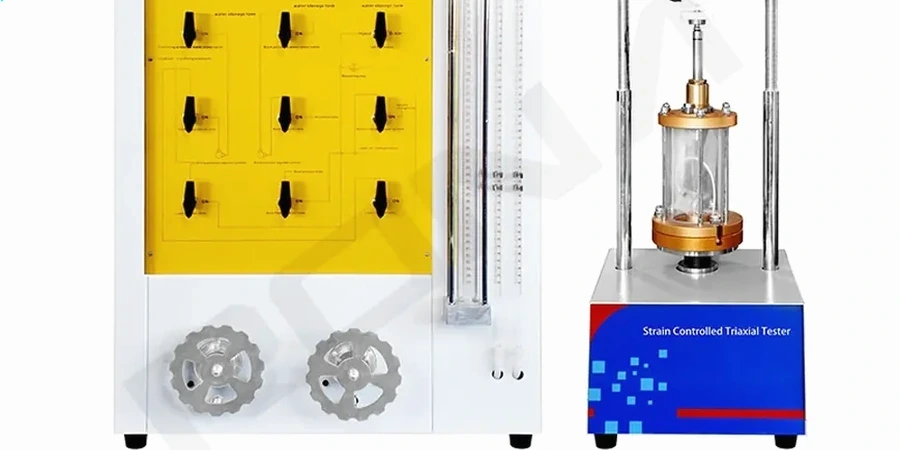
Our triaxial cell is a Wykeham Farrance-style setup capable of confining pressures up to 2 MPa, equipped with a high-precision volume change device and an automated data acquisition system that logs at intervals fine enough to catch the subtle peak of a heavily overconsolidated silt. The greatest technical risk in testing soils from New Westminster is sample disturbance during transport from the site, particularly in the sensitive Salish sediments found at depth. A disturbed sample yields a falsely low peak strength, leading to an overly conservative and costly foundation design, or worse, a misinterpreted strain-softening behavior that misses the potential for progressive failure in a slope stability analysis along the Fraser River escarpment. We mitigate this by coordinating directly with the drill crew on site, using thin-walled Shelby tubes and ensuring immediate wax-sealing, so the specimen that arrives at our lab accurately represents the in-situ state of stress.

Need a geotechnical assessment?

Reply within 24h.

Email: info@geotechnicalengineering.vip

Explanatory video

Relevant standards

ASTM D4767-11: Standard Test Method for Consolidated Undrained Triaxial Compression Test for Cohesive Soils, ASTM D2850-15: Standard Test Method for Unconsolidated-Undrained Triaxial Compression Test on Cohesive Soils, CSA A23.3-14: Design of Concrete Structures (Anchorage and foundations referencing soil parameters), NBCC 2015: National Building Code of Canada (Geotechnical input for seismic site classification)

Reference parameters

ParameterTypical value
Test Standard (CU with Pore Pressure)ASTM D4767-11
Test Standard (Unconsolidated Undrained)ASTM D2850-15
Specimen Diameter35 mm to 100 mm
Maximum Cell Pressure Capacity2000 kPa
Measured Parametersc', φ', σ'₁/σ'₃, Af, E, ν
Typical Failure Strain Rate0.05% to 1% per minute
Peak Effective Friction Angle (Local Till)32° to 38°

Common questions

What is the approximate cost for a triaxial test program on a New Westminster site?

A standard program of three CIU triaxial tests on undisturbed samples, including the consolidation and shear stages with pore pressure measurement, typically ranges from CA$2,750 to CA$3,920 depending on the material type and the required effective confining pressures. We provide a formal quote after reviewing the borehole logs and your geotechnical consultant's specific requirements.

When should I specify a triaxial test instead of just using pocket penetrometer or SPT correlations?

You should specify a triaxial test whenever the project involves a risk of large deformations, such as a deep excavation adjacent to a heritage building in Downtown New Westminster, or when you are designing a critical lifeline structure. Correlations from SPT or Atterberg limits are useful for preliminary design, but they cannot capture the effective stress path or the strain-softening behavior of a sensitive soil. For a final design that optimizes the factor of safety, the friction angle and cohesion from a triaxial test are essential.

How do you handle sampling in the soft soils near the Fraser River to ensure a valid triaxial result?

Sampling in the soft, saturated soils of the Fraser River floodplain is the most critical step. We coordinate with experienced drilling contractors who use thin-walled Shelby tubes pushed at a steady, rapid rate, with no rotation. The sample is immediately extruded in the field, visually logged, and sealed with multiple coats of paraffin wax. It is transported upright in cushioned carriers to prevent vibration, and we perform the triaxial test promptly to minimize any chemical or moisture changes in the specimen.

Location and service area

We serve projects in New Westminster and surrounding areas.

View larger map