GEOTECHNICALENGINEERING
NEW WESTMINSTER
HomeUnderground ExcavationsGeotechnical design of deep excavations

Deep Excavation Geotechnical Design in New Westminster

Rigorous testing. Clear reporting.

LEARN MORE

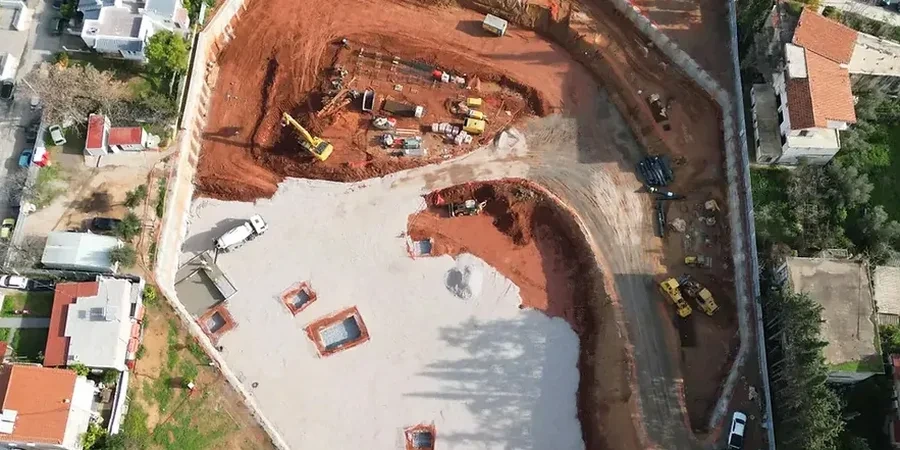
A Link-Belt 250 X4 with a fully instrumented Kelly bar advances through dense glacial till on a confined downtown lot in New Westminster. The rig's crowd force reads 18 MPa as the auger encounters a buried channel deposit at 14 meters. Our team monitors the real-time drilling parameters from a tablet inside the site trailer, correlating torque and penetration rate with the stratigraphic model built from previous CPT soundings along Columbia Street. That level of precision is what deep excavation design demands here. The city's 49.2-degree latitude means winter construction windows are tight, and the Fraser River's proximity keeps the water table within 3 meters of grade in most neighborhoods. We design shoring systems—soldier pile and lagging, secant pile walls, or diaphragm walls—that account for both the seasonal high groundwater and the seismic demands of a region where the Cascadia Subduction Zone shapes every geotechnical decision. A thorough CPT test campaign usually precedes the structural analysis, giving us continuous soil behavior type profiles that inform the lateral earth pressure diagrams used in the excavation support design.

In New Westminster's glacial stratigraphy, base heave in the marine clay unit governs the excavation depth more often than the structural capacity of the shoring wall itself.
Our service areas

Our approach and scope

The Quaternary stratigraphy beneath New Westminster is anything but uniform. Glacial advance and retreat left a sequence of Vashon till, glaciomarine stony clay, and pre-Vashon Quadra sands, all of which behave differently under unloading. When you excavate 12 meters for a parkade near New Westminster Station, the basal heave risk in the underlying normally consolidated clay demands a careful slope stability check using undrained shear strength profiles from field vane tests. We typically see Su values ranging from 25 to 65 kPa in the upper 20 meters of the marine clay unit. Tieback anchors drilled into the competent till at a 15-degree inclination provide the horizontal restraint needed to limit wall deflections below the 25 mm threshold that protects adjacent heritage buildings on Front Street. Groundwater control is equally critical. A wellpoint system or deep wells with submersible pumps running at 60 to 120 L/min per well are often required to lower the phreatic surface below the excavation base. The design must also satisfy the 2018 BC Building Code and CSA A23.3 requirements for temporary works with a minimum factor of safety of 1.5 against basal heave in fine-grained soils.
Deep Excavation Geotechnical Design in New Westminster
Technical reference — New Westminster

Local ground factors

New Westminster's urban core was rebuilt on a steep riverfront after the 1898 fire, and much of the downtown sits on fill placed over the original tidal flats. That legacy creates a dual challenge for deep excavations: uncontrolled fill with brick fragments and timber piles from the early 1900s overlying compressible marine sediments. In 2017, a shoring wall on Carnarvon Street experienced unexpected lateral movement when a buried timber crib wall—unmarked on any municipal record—was exposed at 4 meters depth. We now run ground-penetrating radar surveys as standard practice before designing any excavation over 3 meters deep in the downtown grid. The other major risk driver is the Fraser River's hydraulic influence. During the spring freshet in May and June, river stage can rise by 2 meters, increasing the hydraulic gradient under the excavation base and elevating the risk of piping in silty sand layers. Our designs incorporate a critical gradient analysis with a factor of safety of 2.0 against internal erosion, and we specify real-time piezometer monitoring that alerts the site team if pore pressures deviate from the predicted baseline.

Need a geotechnical assessment?

Reply within 24h.

Email: info@geotechnicalengineering.vip

Relevant standards

NBCC 2015 (National Building Code of Canada), CSA A23.3-14 (Design of Concrete Structures), BCBC 2018 (British Columbia Building Code), ASTM D2487 (Soil Classification), CSA S6:19 (Canadian Highway Bridge Design Code)

Reference parameters

ParameterTypical value
Maximum excavation depth analyzed (temporary works)Up to 25 m in dense till
Typical wall system for urban sitesSoldier pile & lagging / Secant pile wall
Groundwater control methodDeep wells / Wellpoint system (60-120 L/min)
Soil unit governing base stabilityNormally consolidated marine clay (Su 25-65 kPa)
Minimum basal heave factor of safety1.5 (per BCBC 2018 / CSA A23.3)
Seismic design considerationCascadia Subduction Zone, Site Class C/D per NBCC
Typical tieback anchor inclination15° to 30° from horizontal
Wall deflection monitoring threshold< 25 mm adjacent to heritage structures

Common questions

What is the cost range for geotechnical design of a deep excavation in New Westminster?

Fees for geotechnical design of deep excavations in New Westminster typically range from CA$2,890 to CA$10,760, depending on the excavation depth, wall type, number of tieback levels, and whether groundwater modeling is required. A 6-meter excavation with soldier piles and one row of tiebacks on a straightforward site will be at the lower end. A 15-meter excavation with secant piles, multiple anchor levels, base grouting, and 3D finite element analysis for a site adjacent to a SkyTrain guideway will be at the higher end. All fees include stamped design drawings and a construction-phase monitoring plan.

What soil conditions in New Westminster most affect deep excavation design?

The two controlling units are the glaciomarine stony clay and the underlying normally consolidated marine clay. The stony clay has high undrained shear strength but contains cobbles and boulders that complicate drilling for soldier piles. The marine clay is weaker, with Su values typically between 25 and 65 kPa, and governs basal heave stability. The contact between these units is often at 10 to 15 meters depth, right in the critical zone for multi-level underground parkades. The Fraser River's proximity means groundwater is usually within 2 to 3 meters of grade.

How do you protect adjacent heritage buildings during deep excavation in downtown New Westminster?

We start with a pre-construction condition survey and vibration monitoring plan for heritage structures on Front Street, Columbia Street, and the surrounding blocks. The shoring wall is designed for a maximum lateral deflection of 25 mm, verified by inclinometers installed in the wall elements. We often specify a secant pile wall rather than soldier piles when within 3 meters of a heritage foundation, because the continuous concrete barrier eliminates the risk of soil raveling between piles. Real-time settlement monitoring with optical survey points and crack gauges triggers a stop-work threshold if movements approach the pre-defined trigger levels.

Location and service area

We serve projects in New Westminster and surrounding areas.

View larger map