GEOTECHNICALENGINEERING
NEW WESTMINSTER
HomeRoadwayFlexible pavement design

Flexible Pavement Design in New Westminster

Rigorous testing. Clear reporting.

LEARN MORE

New Westminster's pavement infrastructure contends with a complex geological legacy. The city sits at a dynamic interface where upland glacial till meets the compressible silts and clays of the Fraser River floodplain, a condition that the National Building Code of Canada (NBCC) specifically addresses for seismic and settlement-sensitive design. In our experience, a standard pavement section simply does not work here. The native soils vary dramatically within a few hundred meters, demanding a flexible pavement design approach that accounts for differential settlement and lateral spreading potential. Following CSA A23.3 and relevant ASTM standards, we focus on the structural number required to bridge these variable subgrades. A proper grain-size analysis becomes the foundational step, revealing the fines content that dictates drainage behavior and frost susceptibility beneath the asphalt layers.

A pavement section in New Westminster is only as reliable as its subgrade assessment; ignoring the local clay's shrink-swell potential can halve the design life.
Our service areas

Our approach and scope

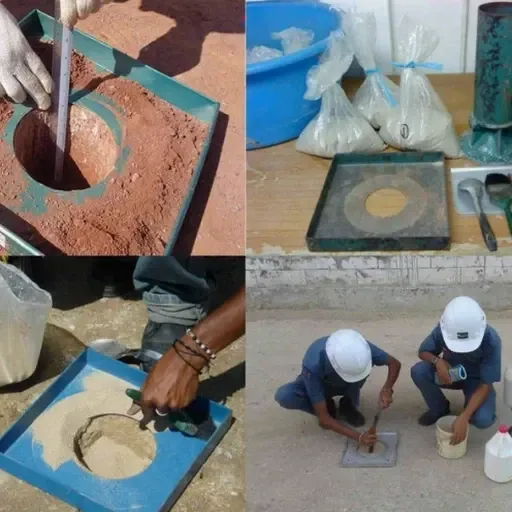
The contrast between Queensborough and the Uptown area illustrates why localized flexible pavement design matters. Queensborough, built on deep, soft marine clays, experiences ongoing subsidence that can rut a poorly designed pavement in a few seasons. Uptown, resting on dense glacial till, provides a firm base but introduces challenges with groundwater interflow during the rainy season. Our methodology integrates the CBR road test to quantify subgrade strength under soaked conditions, simulating the worst-case moisture scenario typical for Metro Vancouver. We pair this with resilient modulus back-calculations to optimize the asphalt concrete and granular base thicknesses. For projects near the Brunette River, where organic silts are prevalent, incorporating in-situ permeability measurements helps us design drainage layers that prevent the base from becoming saturated and losing structural capacity under repeated loading.
Flexible Pavement Design in New Westminster
Technical reference — New Westminster

Local ground factors

New Westminster's urban core has expanded significantly since the Great Fire of 1898, with significant redevelopment pressure on former industrial lands along the waterfront. Historical fill materials—often a mix of brick, wood waste, and uncontrolled granular debris—lie beneath many downtown parking areas and access roads. These unconsolidated fills create unpredictable settlement patterns that rigid pavement simply cannot tolerate without cracking. We routinely encounter this issue when designing flexible pavements for brownfield redevelopments; the solution involves a reinforced geotextile separator and a sacrificial leveling course to bridge soft spots. The risk of ignoring this historical context is severe: alligator cracking within the first three years and costly base failures that require complete reconstruction rather than simple asphalt overlays.

Need a geotechnical assessment?

Reply within 24h.

Email: info@geotechnicalengineering.vip

Relevant standards

NBCC 2020: Part 4 Structural Design, including seismic provisions, CSA A23.1/A23.2: Concrete materials and methods of test, ASTM D1557: Standard Test Methods for Laboratory Compaction Characteristics of Soil, ASTM D1883: Standard Test Method for CBR of Laboratory-Compacted Soils

Reference parameters

ParameterTypical value
Design Traffic (ESALs)Projected 20-year cumulative
Subgrade CBR (%)1.5 to 8+ typical range
Asphalt Layer Modulus (MPa)2500-3500 depending on PGAC grade
Granular Base Thickness (mm)150-300 per structural analysis
Drainage Coefficient (mi)0.8-1.2 based on moisture exposure
Reliability Level85%-95% per CSA guidelines
Frost Protection Depth (mm)Minimum 600-800 in clay soils

Common questions

What is the typical cost range for a flexible pavement design package in New Westminster?

Depending on the project scope—whether it's a small parking lot or a multi-lane arterial road—the engineering design fee generally falls between CA$1,960 and CA$7,220. This includes the geotechnical investigation, lab testing for CBR and gradation, and the final pavement structure report sealed by a professional engineer.

How does the local glacial till affect pavement performance compared to the floodplain soils?

The dense glacial till found in the Uptown area provides excellent structural support with high CBR values, often allowing for thinner pavement sections. In contrast, the Fraser River floodplain silts and clays are highly moisture-sensitive. They lose significant strength when saturated during the rainy season, requiring solid drainage layers and thicker granular bases to prevent subgrade failure.

Which asphalt binder grade do you recommend for the Lower Mainland climate?

For New Westminster's climate, which sees mild winters and warm summers, we typically specify a Performance Graded Asphalt Cement (PGAC) like PG 58-34 or PG 64-28. The specific grade depends on the traffic volume and the location's exposure, but the goal is always to resist thermal cracking in winter while preventing rutting during peak summer temperatures.

Do I need a geotechnical investigation for a simple residential driveway repaving?

While a full pavement design study might not be necessary for cosmetic repaving, we strongly recommend at least a basic subgrade evaluation. In neighborhoods built on fill or near the ravines, we have seen driveways fail in less than two years due to settlement of uncontrolled material beneath the asphalt. A small upfront investigation can confirm whether the base needs reinforcement.

Location and service area

We serve projects in New Westminster and surrounding areas.

View larger map