GEOTECHNICALENGINEERING
NEW WESTMINSTER
HomeIn-Situ TestingField density test (sand cone method)

Field Density Testing with Sand Cone Method in New Westminster

Rigorous testing. Clear reporting.

LEARN MORE

New Westminster sits at just 60 meters above sea level on the north bank of the Fraser River, a position that has shaped its development since 1859. The city’s hillside terrain and proximity to active waterfronts mean that compaction control is not just a specification checkbox—it is what keeps retaining walls standing and pavements intact through wet winters. When fill is placed behind a new foundation or utility trench is backfilled along Columbia Street, the sand cone density test provides the direct, physical verification that no nuclear gauge can match. In our experience across the Royal City, the difference between 95% and 92% compaction often shows up two years later as a cracked sidewalk or a settled service connection. We run each test according to ASTM D1556 and D698, combining field density measurement with laboratory Proctor curves to give you a defensible, auditable result that the city’s building officials recognize without hesitation. For deeper site characterization before placing structural fill, we often pair this test with a CPT investigation to map out the stratigraphy that will receive the engineered fill.

In New Westminster’s variable glacial soils, a properly executed sand cone test remains the most defensible method for compaction acceptance—no calibration curves, no radiation, just mass and volume.
Our service areas

Our approach and scope

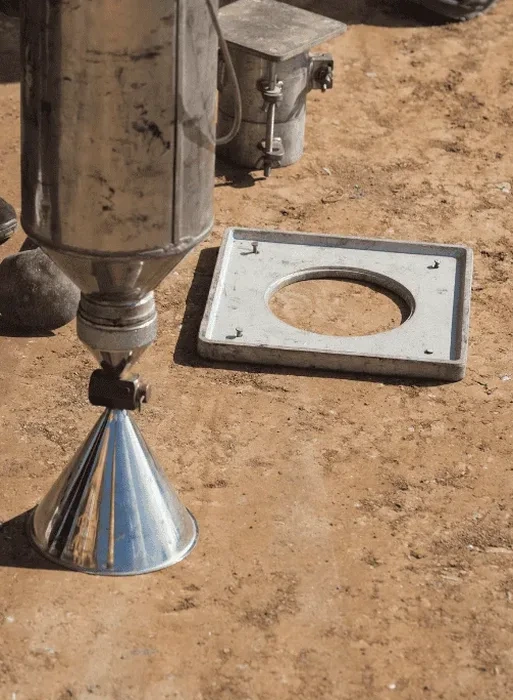
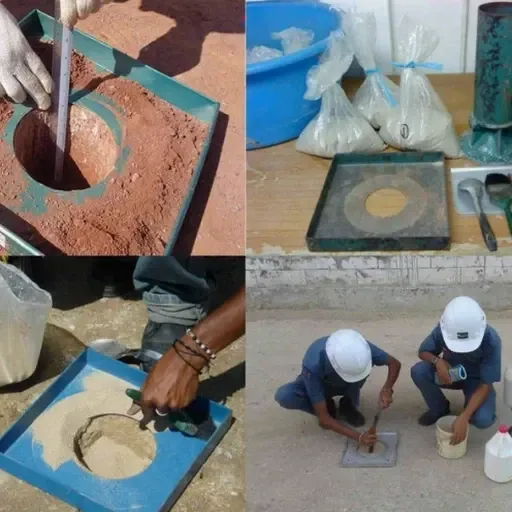
New Westminster’s geology is dominated by glacial till and advance outwash deposits overlying sedimentary bedrock, with pockets of compressible marine silt along the Fraser River flats. In Queensborough, the water table can sit less than a meter below grade, which directly affects the moisture conditioning of fill and the stability of the sand cone excavation. The method itself relies on calibrated Ottawa sand conforming to ASTM D1556, poured through a standardized cone into a carefully excavated hole at the compacted surface. The volume of sand required to fill the hole, divided by the mass of soil removed, gives the in-place wet density—and paired with the moisture content from a representative sample, we calculate the dry density and compaction percentage against the laboratory Proctor. Unlike nuclear methods, the sand cone test is not influenced by soil chemistry or mineralogy, which proves critical in the Fraser Valley’s organics-rich soils. Our technicians carry sand cones with multiple base plate sizes to accommodate everything from fine sands to coarse gravels, ensuring the hole volume is captured accurately regardless of the gradation encountered.
Field Density Testing with Sand Cone Method in New Westminster
Technical reference — New Westminster

Local ground factors

The contrast between the hillside neighborhoods of Sapperton and the low-lying Queensborough area illustrates why standardized density testing matters. In Sapperton, compacted fill over glacial till behaves predictably—settlement is minimal when compaction hits 95% of Standard Proctor. But in Queensborough, where the underlying soils include up to 15 meters of soft Fraser River sediments, even properly compacted structural fill can experience differential settlement if the subgrade is not improved first. The sand cone test gives us a snapshot at the surface, but it cannot tell you what is happening five meters below. When we see a project on Marine Way where the fill density passes but the pavement still cracks within a year, the culprit is almost always subgrade consolidation under the fill’s own weight. That is why we never recommend relying on density testing in isolation for sites near the Fraser’s floodplain. A comprehensive approach that includes subgrade characterization and preloading design yields a pavement or foundation that performs for decades, not just until the next wet season.

Need a geotechnical assessment?

Reply within 24h.

Email: info@geotechnicalengineering.vip

Relevant standards

ASTM D1556 – Standard Test Method for Density of Soil in Place by the Sand-Cone Method, ASTM D698 – Standard Test Methods for Laboratory Compaction Characteristics of Soil Using Standard Effort, ASTM D2216 – Standard Test Methods for Laboratory Determination of Water Content of Soil and Rock by Mass, CSA A23.3 – Design of Concrete Structures (compaction acceptance criteria referenced), NBCC 2020 – National Building Code of Canada (geotechnical site requirements)

Reference parameters

ParameterTypical value
Test standardASTM D1556 / ASTM D698
Material applicabilitySoils with max particle size < 50 mm
Typical test depth150–200 mm below surface
Density reportingWet density, dry density, % Proctor
Calibration frequencyEvery 14 days or 50 tests, whichever first
Moisture determinationOven-dry or microwave method per ASTM D2216
Base plate options4.5″, 6″, and 12″ diameters

Common questions

How much does a sand cone density test cost in New Westminster?

For a standard compaction test including the field density measurement and laboratory Proctor correlation, the cost ranges from CA$130 to CA$180 per test point, depending on the number of tests per mobilization and the travel distance within the Lower Mainland. Volume discounts typically apply for projects requiring more than 10 test locations in a single day.

How many density tests do I need for my project in New Westminster?

The frequency depends on the type of work and the governing specification. For structural fill under buildings, the MMCD and geotechnical reports commonly require one test per lift per 500 square meters of area, or one test per 30 linear meters of trench backfill. We work with your geotechnical engineer to establish a testing schedule that meets both the specification and the city’s acceptance criteria.

Can the sand cone test be used on gravel or crushed rock?

Yes, provided the maximum particle size does not exceed 50 mm. For base course materials with larger aggregates, we use a 12-inch diameter base plate and a larger excavation volume to maintain accuracy. If the material contains cobbles or boulders, we recommend switching to a water replacement method or a nuclear gauge with proper correlation.

What is the difference between Standard Proctor and Modified Proctor?

Standard Proctor (ASTM D698) applies 12,400 ft-lbf/ft³ of compactive effort, while Modified Proctor (ASTM D1557) applies 56,000 ft-lbf/ft³. Most building and utility projects in New Westminster reference Standard Proctor. Modified Proctor is typically reserved for airport runways, heavy industrial pavements, and high-stress applications. We run the Proctor that matches your specification—misapplying the reference curve can result in either overcompaction or undercompaction acceptance errors.

How long does it take to get the test results?

The field density measurement itself takes about 15–20 minutes per location. The laboratory moisture content determination requires overnight oven drying per ASTM D2216, so final reports with dry density and compaction percentage are typically delivered the next business day. For time-sensitive projects, we can use a microwave drying method to provide preliminary results within two hours, followed by the formal oven-dry confirmation.

Location and service area

We serve projects in New Westminster and surrounding areas.

View larger map